

CGHS Facilities to Dependent Sons or Brothers with Critical or Terminal Illnesses – Decentralised STC Mechanism : MoHFW OM dated 26.10.2026
F. No. S.11030/54/2023-EHS (8248513)/1/3909989/2026
Government of India
Ministry of Health & Family Welfare
(EHS Section)
Kartavya Bhavan-1, New Delhi
Dated: 26-10-2026
OFFICE MEMORANDUM
Subject: Consideration of cases relating to extension of CGHS facilities to dependent sons/brothers suffering from critical/terminal illnesses under the decentralised STC mechanism – reg.
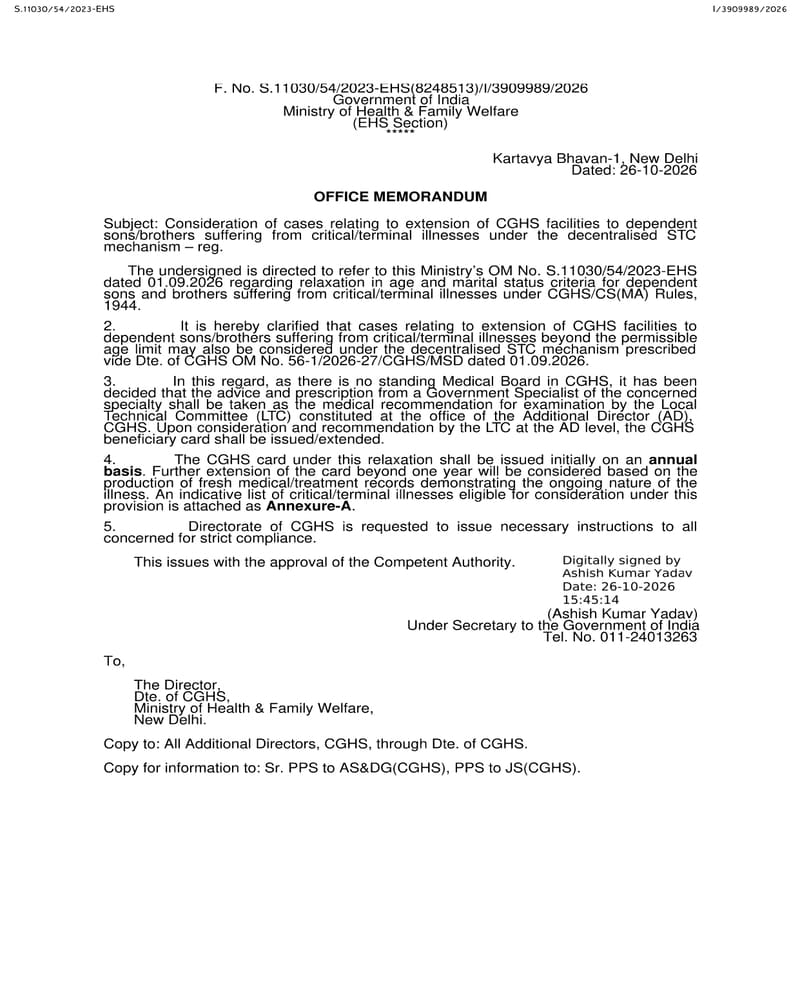
The undersigned is directed to refer to this Ministry’s OM No. S.11030/54/2023-EHS dated 01.09.2026 regarding relaxation in age and marital status criteria for dependent sons and brothers suffering from critical/terminal illnesses under CGHS/CS(MA) Rules, 1944.
2. It is hereby clarified that cases relating to extension of CGHS facilities to dependent sons/brothers suffering from critical/terminal illnesses beyond the permissible age limit may also be considered under the decentralised STC mechanism prescribed vide Dte. of CGHS OM No. 56-1/2026-27/CGHS/MSD dated 01.09.2026.
3. In this regard, as there is no standing Medical Board in CGHS, it has been decided that the advice and prescription from a Government Specialist of the concerned specialty shall be taken as the medical recommendation for examination by the Local Technical Committee (LTC) constituted at the office of the Additional Director (AD), CGHS. Upon consideration and recommendation by the LTC at the AD level, the CGHS beneficiary card shall be issued/extended.
4. The CGHS card under this relaxation shall be issued initially on an annual basis. Further extension of the card beyond one year will be considered based on the production of fresh medical/treatment records demonstrating the ongoing nature of the illness. An indicative list of critical/terminal illnesses eligible for consideration under this provision is attached as Annexure-A.
5. Directorate of CGHS is requested to issue necessary instructions to all concerned for strict compliance.
This issues with the approval of the Competent Authority.
Digitally signed by
(Ashish Kumar Yadav)
Under Secretary to the Government of India
Tel. No. 011-24013263
To,
The Director,
Dte. of CGHS,
Ministry of Health & Family Welfare,
New Delhi.
ANNEXURE-A
LIST OF 42 CRITICAL AND TERMINAL DISEASES
For consideration of relaxation in the age criteria for unmarried dependent sons/brothers under CGHS/CS (MA) Rules, 1944 (OM dated 01.09.2026)
| Sl. No. | Name of disease / condition |
| 1 | All patients requiring Major Organ Transplant/Bone Marrow Transplant OR patients who are post-organ transplant/bone marrow transplant. |
| 2 | All Malignant tumors including both solid tumors and hematological malignancies. |
| 3 | Congenital Heart Disease. |
| 4 | Eisenmenger Syndrome. |
| 5 | Post Cardiovascular Implantable Electronic Devices (PCD/CRT-D) with heart failure (EF <35%). |
| 6 | Symptomatic, hemodynamically significant Valvular Heart Disease. |
| 7 | Severe Left Ventricular Dysfunction with EF <35%. |
| 8 | Cardiomyopathy. |
| 9 | Primary Pulmonary Artery Hypertension. |
| 10 | Aortic Aneurysm/Dissections (Treated/Untreated) (repeated). |
| 11 | Demyelinating disease. |
| 12 | Degenerative/progressive nervous system disorders. |
| 13 | Wilson’s Disease (congenital metabolic and storage disorders). |
| 14 | Refractory Epilepsy Syndromes. |
| 15 | Myasthenia gravis. |
| 16 | Autoimmune disorders. |
| 17 | Immunodeficiency syndromes. |
| 18 | Chronic Liver Disease. |
| 19 | Chronic Pancreatitis. |
| 20 | Chronic Bleeding Disorders. |
| 21 | Congenital hemolytic anemias. |
| 22 | Thrombotic microangiopathy – Hemolytic Uremic Syndrome. |
| 23 | Budd Chiari Syndrome. |
| 24 | Adrenal cancer/functioning adrenal tumors. |
| 25 | Diabetes Mellitus type 1. |
| 26 | Endogenous Cushing’s syndrome. |
| 27 | Panhypopituitarism. |
| 28 | Chronic primary adrenal insufficiency. |
| 29 | Chronic respiratory failure. |
| 30 | Obstructive sleep apnea syndrome requiring treatment with CPAP. |
| 31 | Severe Bronchial asthma. |
| 32 | Chronic Kidney Disease. |
| 33 | Autosomal Dominant Polycystic Kidney Disease. |
| 34 | Congenital/hereditary progressive kidney disorders. |
| 35 | Congenital/acquired Bladder dysfunction requiring continued intervention. |
| 36 | Major congenital genitourinary abnormality with residual functional defects requiring continued management/intervention. |
| 37 | Anatomic Disorders of sexual dysfunction. |
| 38 | Moderate to Severe Psoriasis of PASI >10. |
| 39 | Severe Atopic Dermatitis. |
| 40 | Severe Pemphigus Vulgaris. |
| 41 | Severe Chronic Urticaria. |
| 42 | Vitiligo >10 to <50% BSA. |
Click here to view/download PDF
COMMENTS