
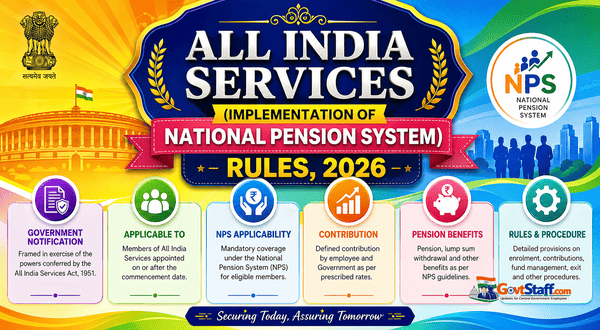

All India Services (Implementation of New Pension System) Rules 2026 – Know your Contribution, Registration, Guidelines & Key Provisions
MINISTRY OF PERSONNEL, PUBLIC GRIEVANCES AND PENSIONS
(Department of Personnel and Training)
NOTIFICATION
New Delhi, the 22nd April, 2026
G.S.R. 307(E).- In exercise of the powers conferred by sub-section (1) of section 3 of the All India Services Act, 1951 (61 of 1951), the Central Government, after consultation with the Government of the States concerned, hereby makes the following rules regulating the method of implementation of the National Pension System, namely:-
1. Short title and commencement. –
(1) These rules may be called the All India Services (Implementation of National Pension System) Rules, 2026.
(2) They shall come into force on the date of their publication in the Official Gazette.
2. Application. –
These rules shall apply to the members of All India Services appointed to the service on or after the 1st day of January, 2004:
Provided that these rules shall not apply to the members of service to whom All India Services (Death cum-Retirement Benefits) Rules, 1958 apply in accordance with any special or general order passed by the Central Government.
3. Definitions. –
(1) In these rules, unless the context otherwise requires, –
(a) “Accounts Officer” means an officer or any other designated authority who is entrusted with the responsibility of registration and generation of Permanent Retirement Account Number (PRAN) to the new subscriber under National Pension System, or an officer who maintains the accounts of a Ministry, Department or office of the Central Government or State Government or Union territory and includes an Accountant General, who is entrusted with the functions of maintaining the accounts or part of accounts of the Central Government or State Government or Union territory;
(b) “Accredited Bank” in relation to a Ministry or Department or Union territory or State Government means the Reserve Bank of India constituted under the Reserve Bank of India Act, 1934 (2 of 1934) or any bank which is appointed to transact business of the Government pertaining to that Ministry or Department or Union territory or State Government and is officially recognised for transfer of funds to the Trustee Bank;
(c) “Accumulated Pension Corpus” means the monetary value of the pension investments accumulated in the Individual Pension Account of a subscriber under the National Pension System;
(d) “Annuity” means periodic payment by the Annuity Service Provider to the subscriber on purchase of annuity plan out of the Accumulated Pension Corpus;
(e) “Annuity Service Provider” means a life insurance company registered and regulated by the Insurance Regulatory and Development Authority and empanelled by the Authority for providing Annuity services to the subscribers of the National Pension System;
(f) “Authority” means the Pension Fund Regulatory and Development Authority established under sub-section
(i) of section 3 of the Pension Fund Regulatory and Development Authority Act, 2013 (23 of 2013) and includes interim Pension Fund Regulatory and Development Authority set up by the Central Government through Resolutions;
(g) “Central Record.keeping Agency” means an agency registered under section 27 of Pension Fund Regulatory and Development Authority Act, 2013 to perform the functions of record.keeping, accounting, administration and customer service for subscribers to schemes;
(h) “Emoluments” means emoluments as specified in rule 5;
(i) “Foreign Service” means service in which a member of service receives his pay with the sanction of the Government from any source other than the Consolidated Fund of India or the Consolidated Fund of a State or the Consolidated Fund of a Union territory;
G) “Government” means
(i) in the case of a member of service serving in connection with the affairs of a State, or who is deputed for service in any company, association or body of individuals whether incorporated or not, which is wholly or substantially owned or controlled by the Government of a State, or in a local authority set up by an Act of the State, the Government of that State;
(ii) in any other case, the Central Government;
(k) “Individual Pension Account” means an account of a subscriber, executed by a contract setting out the terms and conditions under the National Pension System;
(l) “Local Fund administered by Government” means the fund administered by a body which, by law or rule having the force of law, comes under the control of the Government and over whose expenditure the Government retains complete and direct control;
(m) “National Pension System” means the contributory pension system referred to in section 20 of the Pension Fund Regulatory and Development Authority Act, 2013 whereby contributions from a subscriber are collected and accumulated in an Individual Pension Account using a system of points of presence, a Central Recordkeeping Agency and pension funds as may be specified by regulations by Pension Fund Regulatory and Development Authority;
(n) “Pension fund” means an intermediary which has been granted a certificate of registration under sub-section
(3) of section 27 of the Pension Fund Regulatory and Development Authority Act, 2013 by the Authority as a pension fund for receiving contributions, accumulating them and making payments to the subscriber in the manner as may be specified by regulations;
(o) “Permanent Retirement Account Number” means a unique identification number allotted to each subscriber by the Central Recordkeeping Agency;
(p) “Subscriber” means a member of service who subscribes to a scheme of a Pension fund;
(q) “Trustee Bank” means a banking company as defined in the Banking Regulation Act, 1949 (10 of 1949).
(2) Words and expressions used herein and not defined but defined in the All India Services Act, 1951, Fundamental Rules, 1922, the All India Services (Death-cum-Retirement Benefits) Rules, 1958, the Central Civil Services (Pension) Rules, 2021, the Pension Fund Regulatory and Development Authority Act, 2013 or the regulations made under the Pension Fund Regulatory and Development Authority Act, 2013 have the same meanings respectively assigned to them in those Acts or rules or regulations.
4. Registration into National Pension System. –
(1) A member of service to whom these rules apply, shall, immediately on joining service submit an application in Common Subscriber Registration Form or in any other form specified by the Authority along with an option form referred to in rule 10, to the Head of Office or District Treasury Officer or Treasury Officer or any other designated authority for the purpose of registration to the National Pension System.
(2) The Head of Office or District Treasury Officer or Treasury Officer or any other designated authority for the purpose shall on receipt of the application under sub-rule (1), ensure that the application is complete in all respects, countersign it indicating the date of receipt and send it to the Accounts Officer or designated authority for the purpose within three working days of joining of the member of service and the Head of Office or District Treasury Officer or Treasury Officer or any other designated authority for the purpose shall keep a copy of the application form for record.
(3) The Accounts Officer or designated authority shall forward the application of individual subscriber to the Pay and Accounts Officer or State Nodal Officer, as the case may be, within three working days from the date of receipt of the application from the Head of Office or District Treasury Officer or Treasury Officer or any other designated authority for the purpose of registration.
(4) The Pay and Accounts Officer or State Nodal Officer, as the case may be, shall process the application received from the Accounts Officer or designated authority for the purpose and forward it to the Central Recordkeeping Agency through the online system within three working days from the date of receipt of the application from the Accounts Officer or designated authority and the Pay and Accounts Officer or the State Nodal Officer shall also forward duly signed copy of the application to the Central Recordkeeping Agency for record.
(5) The Central Recordkeeping Agency shall complete registration process and allocate a Permanent Retirement Account Number in respect of each member of service in the form specified by the Authority as per the tum-around time specified by the Authority and after completion of the registration process, the Central Recordkeeping Agency shall communicate the Permanent Retirement Account Number to the Pay and Accounts Officer or the State Nodal Officer, as the case may be, and also forward Permanent Retirement Account Number kits to the Subscriber in accordance with the process and tum-around time laid down by the Authority.
(6) The Pay and Accounts Officer or the State Nodal Officer, as the case may be, shall communicate Permanent Retirement Account Number (PRAN) to the concerned Accounts Officer or designated authority immediately.
(7) The Accounts Officer or designated authority for the purpose shall communicate the Permanent Retirement Account Number to the Head of Office or District Treasury Officer or Treasury Officer or any other designated authority immediately.
(8) The Head of Office or District Treasury Officer or Treasury Officer or any other designated authority for the purpose shall intimate the Permanent Retirement Account Number to the Subscriber and shall record the Permanent Retirement Account Number (PRAN) in the Common Subscriber Registration Form or any other form specified by the Authority submitted by the Subscriber and in the service book of the Subscriber and also paste a certified copy of the Common Subscriber Registration Form or any other form specified by the Authority in the service book of the Subscriber within five working days thereafter.
(9) The authorities referred to in sub-rule (2) to sub-rule (8) shall ensure that there is no delay in the process of registration of the member of service in the National Pension System and crediting of first contribution in his Individual Pension Account and the first contribution of the member of service shall be credited in his Individual Pension Account within twenty days of the date of submission of the application under sub-rule (1) or by the last date of the month
in which the member of service joined, whichever is later.
(10) In a case where the process of registration of the member of service in the National Pension System has not been completed before the date of drawal of the salary for the first month or any subsequent month, such salary or salaries shall be paid to the member of service after withholding the amount of contribution as determined in accordance with rule 6.
(11) The amount of the contribution withheld from the salary as well as the amount of interest payable under rule 8 shall be credited to the Individual Pension Account of the member of service as soon as the process of generation of Permanent Retirement Account Number of the member of service in the National Pension System is completed by the Central Recordkeeping Agency and communicated to the Pay and Accounts Officer or the State Nodal Officer.
(12) Action on the option form submitted under sub-rule (1) shall be taken in accordance with rule 10.
5. Emoluments.–
(1) The expression “emoluments” for the purpose of determining the amount of mandatory contribution under the National Pension System includes basic pay as defined in respective pay rules for the members of All India Services and admissible dearness allowance in a calendar month.
(2) Subject to the proviso to sub-rule (1) of rule 7, if a Subscriber had been absent from duty on leave for which leave salary is payable, the amount representing pay and dearness allowance in the leave salary actually drawn shall be taken into account for emoluments for the purpose of this rule.
(3) Subject to the proviso to sub-rule (1) of rule 7, if a Subscriber had been absent from duty or was on extraordinary leave, during whole or part of a calendar month, the pay or the amount representing pay, and dearness allowance in the leave salary which he actually drew for the part of that calendar month during which he was on duty or was on leave for which leave salary is payable, shall be taken into account for emoluments for the purpose of this rule.
(4) If a Subscriber had been under suspension, the subsistence allowance drawn during the period of suspension in a calendar month shall be taken into account for emoluments for the purpose of this rule.
(5) Pay drawn by a Subscriber while on deputation in India shall be taken into account for emoluments for the purpose of this rule.
(6) In the case of a Subscriber on foreign service or deputation outside India, the pay which he would have drawn under the Government had he not been on foreign service or such deputation, shall be taken into account for emoluments.
(7) Where a retired Subscriber, who is re-employed in Government service and to whom these rules are applicable and whose pay on re-employment has been reduced by an amount not exceeding his monthly pension, the element of monthly pension by which his pay is reduced shall be included in emoluments.
6. Contribution by the Subscriber to the National Pension System. –
(1) The National Pension System shall work on defined contribution basis and a Subscriber shall make a contribution of ten per cent. or such other percentage as may be notified by the Central Government from time to time, of his emoluments to the National Pension System every month and the amount of contribution payable shall be rounded off to the next higher rupee.
(2) Contribution may be made by the Subscriber, at his option, during the period of suspension:
Provided that where, in the final orders passed by the Government on conclusion of the inquiry, the period spent under suspension is treated as duty or leave for which leave salary is payable, contributions to the National Pension System shall be determined based on the emoluments which the Subscriber becomes entitled to for the period of suspension and the difference of the amount of contribution to be deposited and the amount of contribution already deposited during the period of suspension, shall be credited to the Individual Pension Account of the Subscriber along with interest and the rate of interest for this purpose would be the rate of interest as decided by the Central Government from time to time for the Public Provident Fund deposits.
(3) No contribution shall be made by the Subscriber during the period of absence from duty (whether on leave or otherwise) for which no pay or leave salary is payable.
(4) During the period of transfer on deputation to a Department or organisation under the Central Government or the State Government, the Subscriber shall remain subject to these rules in the same manner, as if he was not so transferred or sent on deputation and will continue to contribute towards National Pension System based on emoluments worked out in accordance with sub-rule (5) of rule-5.
(5) The contributions in respect of any arrears of salary received by the Subscriber due to retrospective increase shall be treated as the contributions for the month in which the payments are made.
(6) The Subscriber shall contribute toward National Pension System during the period spent under probation.
(7) The deduction and crediting of contributions to the Individual Pension Account during foreign service in India or outside India, including deputation to United Nations’ Secretariat or other United Nations’ Bodies, the International Monetary Fund, the International Bank of Reconstruction and Development, or the Asian Development Bank or the Commonwealth Secretariat or any other international organisation, shall be regulated in accordance with the instructions issued by the Department of Personnel and Training from time to time and the procedure laid down by the Authority.
(8) The Accounts Officer or designated authority for this purpose shall deduct the contribution from the salary of the member of service and send the bill to the Pay and Accounts Officer or State Nodal Officer, as the case may be, along with details of contributions deducted in respect of each Subscriber on or before the twentieth day of each month.
(9) A Subscriber may, at his option, make contribution in excess of the contribution specified in sub-rule (1) in accordance with the procedure laid down by the Authority and the Central Government.
(10)(a) The Pay and Accounts Officer or the State Nodal Officer, as the case may be, based on the details of contributions in respect of each Subscriber sent by the Accounts Officer or designated authority for the purpose to Pay and Accounts Officer or State Nodal Officer under sub-rule (8), shall prepare and upload a Subscription Contribution File and generate a Transaction ID by the twenty-fifth day of each month.
(b) The Pay and Accounts Officer or the State Nodal Officer, as the case may be, shall remit the contribution to the Trustee Bank through the Accredited Bank by the last working day of each month:
Provided that the contribution for the month of March shall be remitted by the Pay and Accounts Officer or the State Nodal Officer to the Trustee Bank through the Accredited Bank on the first working day of the month of April.
(c) In case of delay in crediting of contribution to the Individual Pension Account of the Subscriber beyond the prescribed timeline due to factors not attributable to the Subscriber, the amount shall be credited to the Individual Pension Account of the Subscriber along with interest for the delayed period, as determined in accordance with rule 8.
7. Contribution by the Government.–
(1) The Government shall make contribution of fourteen per cent. or such other percentage as may be notified from time to time, of the emoluments of a member of service to the Individual Pension Account of the Subscriber every month and the amount of contribution payable shall be rounded off to the next higher rupee:
Provided that in cases where leave is granted to the Subscriber on medical ground or due to his inability to join or rejoin duty on account of civil commotion; or for pursuing higher studies considered useful in discharge of his official duty, and during such leave, leave salary is not payable or is payable at a rate which is less than full pay, the Government shall make contribution equal to fourteen per cent or such other percentage as may be notified from time to time, of the notional emoluments comprising the amount representing pay and dearness allowance in the leave salary, referred to in rule 5.
(2) Subject to the proviso to sub-rule (1), no contribution shall be made by the Government for the period during which the Subscriber is not required to make contribution in accordance with these rules.
(3) In the case of a Subscriber under suspension, contribution shall be made by the Government on the basis of the emoluments determined by taking into account the subsistence allowance paid to the Subscriber during the period of such suspension:
Provided that no contribution shall be made by the Government during the period of suspension where the Subscriber had opted not to pay his contribution during the said period of suspension:
Provided further that where, in the final orders passed by the Government on conclusion of the inquiry, the period spent under suspension is treated as duty or leave for which leave salary is payable, contributions by the Government to the National Pension System shall be determined based on the emoluments which the Subscriber becomes entitled to for the period of suspension and the difference of the amount of contribution to be deposited by the Government and the amount of contribution already deposited during the period of suspension, shall be credited to the Individual Pension Account of the Subscriber along with interest and the rate of interest for this purpose shall be the rate of interest as decided by the Central Government from time to time for the Public Provident Fund deposits.
(4) Contribution by the Government to the Individual Pension Account during foreign service in India or outside India, including deputation to United Nations’ Secretariat or other United Nations’ Bodies, the International Monetary Fund, the International Bank of Reconstruction and Development, or the Asian Development Bank or the Commonwealth Secretariat or any other international organisation, shall be regulated in accordance with the orders issued by Department of Personnel and Training from time to time and the procedure laid down by the Authority.
(5) The provisions regarding time line as applicable in the case of remittance of contribution by the Subscriber would also be applicable for remittance of contribution by the Government and in case there is a delay in crediting of contribution to the Individual Pension Account of the Subscriber beyond the prescribed timeline due to factors not attributable to the Subscriber, the amount shall be credited to the Individual Pension Account of the Subscriber along with interest for the delayed period, as determined in accordance with rule 8.
8. Interest on delayed deposit of contributions.–
(1) In case of delay, due to factors not attributable to the Subscriber, in, –
(a) commencement of monthly contributions on account of delay in registration of the Subscriber in the National Pension System beyond the time limits specified in rule 4; or
(b) deduction of monthly contribution from the salary of the Subscriber or crediting to his Individual Pension Account beyond the time limit specified in rule 6; or
(c) crediting of the monthly contributions by the Government to the Individual Pension Account of the Subscriber beyond the time limit specified in rule 7,
the amount of contribution may be credited to the Individual Pension Account of the Subscriber along with interest for the delayed period and the interest shall be credited to the Individual Pension Account of the Subscriber within a period of thirty days of the crediting of the amount of contribution and the rate of interest for this purpose shall be the rate of interest, as decided by the Central Government from time to time, for the Public Provident Fund deposits:
Provided that the rate of interest applicable for the period from 1st January, 2004 to 31st December, 2012 shall be as notified by Department of Financial Services in its Notification No. 1/3/2016-PR dated 31st January, 2019 and by Department of Expenditure in its Office Memorandum No. 1(21)/EV/2018 dated 12th April, 2019.
(2)(a) Every case of delay in registration of the Subscriber in the National Pension System or commencement of contributions under rule 4 or deduction and crediting of monthly contribution of the Subscriber under rule 6 or crediting of monthly contribution by the Government in the Individual Pension Account of the Subscriber under rule 7 shall be examined by the Head of Department or Chief Controller of Accounts or Accountant General or the competent authority as specified for fixation of responsibility.
(b) If the Head of Department or Chief Controller of Accounts or Accountant General or the competent authority as specified is satisfied that the delay is caused on account of administrative lapse, the delinquent official or officials shall be liable to pay the amount of pecuniary loss to the Government on account of payment of interest.
(c) The responsibility and the amount of liability on the part of the delinquent official or officials shall be determined in the same manner as in the case of delayed deduction or remittance of Tax Deduction at Source under Section 398(3) of the Income-tax Act, 2025 (30 of 2025) and this shall be without prejudice to any disciplinary action which the disciplinary authority may propose to take against the official or officials responsible for the administrative lapse in this respect.
9. Investment of the Accumulated Pension Corpus.–
The Accumulated Pension Corpus in respect of a Subscriber shall be invested by such pension fund or funds and in such manner as may be notified by the Authority.
10. Option to avail benefits on death or invalidation or disability of Subscriber during service.–
(1) Every member of service covered under the National Pension System shall, at the time of joining service, exercise an option in Form 1 for availing benefits under the National Pension System or under the All India Services (Death-cum-Retirement Benefits) Rules, 1958 or the Central Civil Service (Extraordinary Pension) Rules, 2023 in the event of his death or boarding out on account of disablement or retirement on invalidation and the members of service, who are already in Government service and are covered by the National Pension System, shall also exercise such option as soon as possible after the commencement of these rules.
(2) The option shall be exercised to the Head of Office or District Treasury Officer or Treasury Officer or any other designated authority for the purpose who will accept the same after verifying all the facts submitted therein and place it in the service book and a copy of the option shall be forwarded by the Head of Office or District Treasury Officer or Treasury Officer or any other designated authority for the purpose to the Central Recordkeeping Agency through the Accounts Officer or designated authority for the purpose and the Pay and Accounts Officer or State Nodal Officer for their record, and such officer shall also make suitable entry in the online system indicating the details
regarding the option exercised by the member of service.
(3) (a)(i) Every member of service shall, along with the option in Form 1, also submit details of family in Form 2 to the Head of Office or District Treasury Officer or Treasury Officer or any other designated authority;
(ii) if the member of service has no family, he shall furnish the details in Form 2 as soon as he acquires a family.
(b) The member of service shall communicate to the Head of Office or District Treasury Officer or Treasury Officer or any other designated authority for the purpose any subsequent change in the size of his family, including the fact of marriage of his child.
(c) (i) As and when a disability referred to in rule 22 of the All India services (Death-cum-Retirement Benefits) Rules, 1958 manifests itself in a child which makes him unable to earn his living, the fact shall be brought to the notice of the Head of Office or District Treasury Officer or Treasury Officer or any other designated authority for the purpose duly supported by a Medical Certificate from a Medical Officer, not below the rank of a Civil Surgeon and this may be
indicated in Form 2 by the Head of Office or District Treasury Officer or Treasury Officer or any other designated authority for the purpose;
(ii) as and when the claim for family pension arises, the legal guardian of the child may make an application supported by a fresh medical certificate from a Medical Officer, not below the rank of Civil Surgeon, that the child still suffers from the disability.
(d)(i) The Head of Office or District Treasury Officer or Treasury Officer or any other designated authority for the purpose shall, on receipt of the Form 2, acknowledge its receipt and all further communications received from the member of service in this behalf, countersign it indicating the date of receipt and get it pasted on the service book of the member of service concerned;
(ii) the Head of Office or District Treasury Officer or Treasury Officer or any other designated authority for the purpose on receipt of communication from the member of service regarding any change in the size of family shall incorporate such a change in Form 2.
(4)(i) The option exercised under sub-rule (1), may be revised any number of times by the Subscriber before his retirement by making a fresh option intimating his revised option to the Head of Office or District Treasury Officer or Treasury Officer or any other designated authority for the purpose and on receipt of the revised option, the Head of Office or District Treasury Officer or Treasury Officer or any other designated authority for the purpose and the Pay and Accounts Officer shall take further action as mentioned in sub-rule (2);
(ii) a Subscriber who is discharged on invalidation or disability shall be given an opportunity to submit a fresh option at the time of such discharge;
(iii) where such Subscriber does not exercise a fresh option or is not in a position to exercise fresh option at the time of discharge, the option already exercised by the Subscriber shall become operative;
(iv) where no option was exercised by the Subscriber and the Subscriber is not in a position to exercise an option at the time of discharge, his case will be regulated in accordance with sub-rule (6).
(5) In the case of death of a Subscriber while in service, the last option exercised by the deceased Subscriber before his death shall be treated as final and the family shall have no right to revise the option.
(6)(i) Where a Subscriber who did not exercise an option under sub-rule (1) dies before completion of service of fifteen years or within three years of the notification of these rules, his family will be granted family pension in accordance with the provisions of the All India services (Death-cum-Retirement Benefits) Rules, 1958 or the Central Civil Services (Extraordinary Pension) Rules, 2023 as the case may be, as a default option;
(ii) where a Subscriber is discharged from Government service on invalidation or disability before completion of service of fifteen years or within three years of the notification of these rules without exercising an option under sub-rule (1), and is also not in a position to exercise an option at the time of discharge, he shall be granted invalid pension or disability pension in accordance with the provisions of the All India services (Death cum-Retirement Benefits) Rules, 1958 or the Central Civil Services (Extraordinary Pension) Rules, 2023 as the case may be, as default option;
(iii) in all other cases, where no option was exercised by the Subscriber, the claim of the Subscriber on discharge from the service and that of the family on death of the Subscriber, shall be regulated in accordance with the Pension Fund Regulatory and Development Authority (Exits and Withdrawals under National Pension System) Regulations, 2015, as default option.
(7) In cases where the option exercised by the deceased Subscriber in accordance with sub-rule (1) or the default option in accordance with sub-rule (6) for benefit under the All India services (Death-cum-Retirement Benefits) Rules, 1958 or the Central Civil Services (Extraordinary Pension) Rules, 2023 becomes infructuous on account of non-availability of an eligible member of the family for grant of family pension under the All India services (Death-cum-Retirement Benefits) Rules, 1958 or the Central Civil Services (Extraordinary Pension) Rules, 2023, such option would be deemed to have become invalid and the benefits admissible under the National Pension System shall be granted to the legal heir of the member of service in accordance with the Pension Fund Regulatory and Development Authority (Exits and Withdrawals under National Pension System) Regulations, 2015.
11. Retirement on superannuation or extension of service. –
(1) A Subscriber, who is retired on his attaining the age of superannuation or, if the service of the Subscriber has been extended beyond superannuation, on expiry of such period of extension of service beyond the age of superannuation, shall be entitled to benefits as admissible under the Pension Fund Regulatory and Development Authority (Exits and Withdrawals under National Pension System) Regulations, 2015 to the Subscriber retiring on superannuation.
(2) A member of service shall retire from the service with effect from the afternoon of the last day of the month in which he attains the age of sixty years: Provided that a member of service whose date of birth is the first day of a month shall retire from service on the afternoon of the last day of the preceding month on attaining the age of sixty years:
Provided further that a member of service dealing with budget work or working as a full-time member of a committee which is to be wound up within a short period may be given extension of service for a period not exceeding three months in public interest, with the prior approval of the Central Government:
Provided also that a member of service holding the post of Chief Secretary to a State Government may be given extension of service for a period not exceeding six months on the recommendations made by the concerned State Government with full justification and in public interest, with the prior approval of the Central Government.
(3) Notwithstanding anything contained in sub-rule (2), the Central Government may, if it considers necessary in the public interest so to do, give extension in service to the incumbents of the posts of the Cabinet Secretary, Defence Secretary, Home Secretary, Director (Intelligence Bureau), Secretary (Research and Analysis Wing) and Director (Central Bureau of Investigation) for such period as it may deem proper:
Provided that the total term of the Cabinet Secretary who is granted such extension of service shall not exceed four years:
Provided further that the Central Government may, if it considers necessary in public interest to do so, give an extension in service for a further period, not exceeding three months, beyond the period of four years to the Cabinet Secretary:
Provided also that the total term of the other Secretaries and Directors who are granted such extensions of service under these rules shall not exceed two years:
Provided also that the Central Government may, if it considers necessary in public interest so to do, give an extension in service for a further period, not exceeding three months, beyond the period of two years to the Home Secretary and the Defence Secretary.
(4) There is no bar to issue orders under this rule granting extension of service to a member of the Service with retrospective effect.
12. Voluntary Retirement from Service.–
(1) A member of service may, after giving at least three months’ previous notice in writing, to the State Government concerned, retire from service on the date on which such member completes thirty years of qualifying service or attains fifty years of age or on any date thereafter to be specified in the notice:
Provided that no member of service under suspension shall retire from service except with the specific approval of the Central Government:
Provided further that the State Government concerned on a request made by the member of service may, if satisfied and for reasons to be recorded in writing, relax the period of notice:
Provided also that a notice under this sub-rule, addressed to the Central Government may be treated as valid as defect in the notice is only formal, and in the absence of a prescribed form, endorsing a copy of the notice amounts to addressing the notice.
(2) A member of service may, after giving three months’ previous notice in writing to the State Government concerned, retire from service on the date on which he completes twenty years of qualifying service or any date thereafter to be specified in the notice:
Provided that a notice of retirement given by a member of service shall require acceptance by the Central Government if the date of retirement on the expiry of the period of notice would be earlier than the date on which the member of the Service could have retired from service under sub-rule (1):
Provided further that a member of service, who is on deputation to a corporation or company wholly or substantially owned or controlled by the government or to a body controlled or financed by the Government, shall not be eligible to retire from the service under this rule for getting himself permanently absorbed in such corporation, company or body:
Provided also that a member of service borne on the cadres of Assam-Meghalaya, Manipur-Tripura, Nagaland and Sikkim may retire from service on the date on which he completes fifteen years of service.
(3) (a) The notice of voluntary retirement given in writing by the member of service under sub-rules (1) and (2) may be withdrawn by the member of service by submitting a request to the competent authority within the period specified in the said notice.
(b) A notice of voluntary retirement given by a member of service may be withdrawn by him, after it is accepted by the competent authority, only with the approval of the competent authority concerned provided the request for such withdrawal is made before the expiry of the period of notice.
(c) In cases where disciplinary proceedings are pending or contemplated against a member of service for the imposition of a major penalty and the disciplinary authority, having regard to the circumstances of the case, is of the view that the imposition of the major penalty of removal or dismissal for service would be warranted, the notice of voluntary retirement given by the officer concerned may not ordinarily be accepted.
(d) In cases where prosecution is contemplated or may have been launched in a court of law against a member of service, the notice of voluntary retirement given by him may not ordinarily be accepted.
(e) The notice of voluntary retirement given by a member of service, who is on study leave or who has not completed a minimum service of three years on completion of study leave, may not ordinarily be accepted.
(4) Where a notice of voluntary retirement is given by a member of service under sub-rules (1) and (2), and the competent authority does not issue any order before the expiry of the period specified in the said notice, the voluntary retirement shall become effective from the date of expiry of the said period:
Provided that a member of service, who has given notice for voluntary retirement under the aforesaid rule shall retire from service on the expiry of the period of three months even if he is placed under suspension after he gave notice:
Provided further that where no order is issued by the competent authority, then after the expiry of the period specified in the notice, the Central Government may issue orders.
(5) For the purpose of this rule the expression ‘competent authority’ shall mean the authority which is empowered to accept notice of voluntary retirement under sub-rules (1) and (2).
(6) Extraordinary leave cannot run concurrently with the period of notice of voluntary retirement given under sub-rules (1) and (2).
(7) The subscriber, on voluntary retirement from service, shall be entitled to benefits admissible under the Pension Fund Regulatory and Development Authority (Exits and Withdrawals under National Pension System) Regulations, 2015 to the subscriber retiring on superannuation.
(8) If the subscriber intends to continue his Individual Pension Account or to defer payment of benefits under the National Pension System beyond the date of retirement, he shall exercise an option in this regard in accordance with the Pension Fund Regulatory and Development Authority (Exits and Withdrawals under National Pension System) Regulations, 2015.
13. Premature Retirement or retirement in advance of the age of superannuation. –
(1) The Central Government may, in consultation with the State Government concerned, require a member of service to retire from service in public interest, after giving such member at least three months’ previous notice in writing or three months’ pay and allowances in lieu of such notice, –
(a) after the review when such member completes fifteen years of qualifying service; or
(b) after the review when such member completes twenty-five years of qualifying service or attains the age of fifty years, as the case may be; or
(c) if the review referred to in (a) or (b) above has not been conducted, after the review at any other time as the Central Government deems fit in respect of such member.
Explanation.–For the purpose of sub-rule (1), “review” means the review of the entire service record of the member of service regarding suitability or otherwise of such member for further retention in the service, to be conducted regularly of each member of such service, firstly, after his completion of fifteen years of qualifying Service, and secondly, after his completion of twenty-five years of qualifying Service or on his attaining the age of fifty years, as the case may be, or if the review referred to in clauses (a) or (b) of this sub-rule has not been conducted in respect of such member, such review may be conducted at any other time as the Central Government deems fit.
(2) State Governments may initiate action and suggest the compulsory retirement in public interest of All India Service officers who have put in thirty years of qualifying service or have attained the age of fifty years after giving them three months’ notice in writing and the orders in each such case shall need to be issued by the Central Government but the formal notification giving effect to the above orders shall be issued by the State Government.
(3) The Government can serve notice of retirement of a member of an All India Service even before he attains the age of fifty years or has completed thirty years of qualifying service, subject to the condition that the actual retirement takes place after he has attained age of fifty or has completed thirty years of qualifying service.
(4) A subscriber, who retires or is retired, in advance of the age of superannuation in accordance with sub rules (1) to (3) shall be entitled to benefits as admissible under the Pension Fund Regulatory and Development Authority (Exits and Withdrawals under National Pension System) Regulations, 2015 to the subscriber retiring on superannuation.
(5) If the Subscriber intends to continue his Individual Pension Account or to defer payment of benefits under National Pension System beyond the date of retirement, he shall exercise an option in this regard in accordance with the Pension Fund Regulatory and Development Authority (Exits and Withdrawals under National Pension System) Regulations, 2015.
14. Resignation from Government service. –
(1) On resignation from a service or a post, unless it is allowed to be withdrawn in the public interest by the appointing authority, the lump sum and the annuity out of the Subscriber’s accumulated pension corpus shall be paid to him in accordance with the regulations notified by the Authority as admissible in the case of exit of a Subscriber from the National Pension System before superannuation:
Provided that such payment of lump sum withdrawal and annuity shall not be made before the expiry of a period of ninety days from the date on which the resignation becomes effective and the Subscriber is relieved of his duty:
Provided further that if the Subscriber dies before the expiry of a period of ninety days from the date on which the resignation becomes effective, the payment shall be made to the person eligible to receive such payment immediately in accordance with the regulations notified by the Authority as admissible in the case of exit of a Subscriber from the National Pension System before superannuation:
Provided also that such person may, at his option, continue to subscribe to the National Pension System with the same Permanent Retirement Account Number, as a non-Government subscriber in accordance with the regulations notified by the Authority.
(2) Where with proper permission, the resignation has been submitted to take up another appointment, whether temporary or permanent, in the same or any other Department of the Central Government or the State Government and the employees of such Department are covered by the National Pension System, the Subscriber shall continue to subscribe to the National Pension System with the same Permanent Retirement Account Number on the new appointment and shall be deemed to be a member of the National Pension System from the date he joined the Government service on a post to which he was first appointed:
Provided that where the employees of such Department or State Government are not covered by the National Pension System, the Subscriber shall be eligible to receive benefits under National Pension System in accordance with the Pension Fund Regulatory and Development Authority (Exits and Withdrawals under National Pension System) Regulations, 2015 as admissible in the case of exit of Subscriber on superannuation:
Provided further that where the employees of such Department or State Government are not covered by the National Pension System, such subscriber may, at his option, continue to subscribe to the National Pension System with the same Permanent Retirement Account Number as a non-Government subscriber, in accordance with the regulations notified by the Authority, in this regard.
(3) (a) The Central Government may permit a member of service to withdraw his resignation in the public interest on the following conditions, namely:
(i) that the resignation was tendered by the member of service for some compelling reasons which did not involve any reflection on his integrity, efficiency, or conduct and the request for withdrawal of the resignation has been made as a result of a material change in the circumstances which originally compelled him to tender the resignation;
(ii) that during the period intervening between the date on which the resignation became effective and the date from which the request for withdrawal was made, the conduct of the member concerned was in no way improper;
(iii) that the period of absence from duty between the date on which the resignation became effective and the date of which the person is allowed to resume duty as a result of permission to withdraw the resignation is not more than ninety days;
(iv) that the post, which was vacated by the member of service on the acceptance of his resignation or any other comparable post, is available.
(b) Request for withdrawal of a resignation shall not be accepted by the Central Government where a member of service resigns from his service or post with a view to take up an appointment in or under a private commercial company or a corporation or company wholly or substantially owned or controlled by the Government or a body controlled or financed by the Government.
(c) Request for withdrawal of resignation shall not be accepted by the Central Government where a member of service resigns from his or her service or post with a view to be associated with, any political parties or any organisation which takes part in politics, or to take part in, or subscribe in aid of, or assist in any other manner, any political movement or political activity or to canvass or otherwise interfere with, or use his influence in connection with, or take part in, an election to any legislature or local authority.
(d) When an order is passed by the Central Government allowing a member to withdraw his resignation and to resume duty, the order shall be deemed to include the condonation of interruption in service but the period of interruption shall not be counted as qualifying service.
15. Benefit on absorption in or under a corporation, company or body.–
(1) A Subscriber who has been permitted to be absorbed in a service or post in or under a Corporation or Company wholly or substantially owned or controlled by the Central Government or a State Government or in or under a Body controlled or financed by the Central Government or a State Government, shall be deemed to have retired from service from the date of such absorption and shall be eligible to receive benefits under the National Pension System in accordance with the Pension Fund Regulatory and Development Authority (Exits and Withdrawals under National Pension System) Regulations, 2015 as admissible in the case of exit of Subscriber on superannuation:
Provided that the Subscriber shall continue to subscribe to the National Pension System with the same Permanent Retirement Account Number in the new organisation if the same system exists in the new organisation and in that case, he shall not receive any benefit under the National Pension System at the time of such absorption but shall receive benefits after exit from the new body or organisation, etc. where Subscriber has been absorbed:
Provided further that where the employees of such autonomous or statutory body or public sector undertaking are not covered by the National Pension System, such subscriber may, at his option, continue to subscribe to the National Pension System with the same Permanent Retirement Account Number as a non Government subscriber, in accordance with the regulations notified by the Authority.
(2) The provisions under sub-rule (1) shall also apply to the Subscribers who are permitted to be absorbed in joint sector undertakings, wholly under the joint control of Central Government and State Governments or Union territory Administrations or under the joint control of two or more State Governments or Union territory Administrations.
Explanation(1). – “Date of absorption” shall be, in case, a Subscriber, –
(a) joins a corporation or company or body on immediate absorption basis, the date on which he actually joins that corporation or company or body;
(b) initially joins a corporation or company or body on foreign service terms, the date from which his unqualified resignation is accepted by the Government; and
Explanation(2). – For the purposes of this rule, ”body” means autonomous body or statutory body.
16. Entitlement on retirement on invalidation.–
(1) The case of a Subscriber acquiring a disability, where the provisions of section 20 of the Rights of Persons with Disabilities Act, 2016 (49 of 2016) are applicable, shall be governed by the provisions of the said section:
Provided that such Subscriber shall produce a disability certificate from the competent authority as prescribed under the Rights of Persons with Disabilities Rules, 2017.
(2) If a Subscriber, in a case where the provisions of section 20 of the Rights of Persons with Disabilities Act, 2016 are not applicable, intends to retire from the service on account of any bodily or mental infirmity which permanently incapacitates him for the service, he may apply to the Competent Authority for benefits on retirement on invalidation:
Provided that an application for benefits on retirement on invalidation submitted by the spouse of the Subscriber failing which by a member of the family of the Subscriber may also be accepted, if the Competent Authority is satisfied that the Subscriber himself is not in a position to submit such application on account of the bodily or mental infirmity:
Provided further that where a Subscriber, who has acquired a disability and in whose case the provisions of section 20 of the Rights of Persons with Disabilities Act, 2016 are applicable, intends to retire under this rule, the Subscriber shall be advised that he has the option of continuing in service with the same pay matrix and service benefits which he is otherwise entitled to and in case, the Subscriber does not withdraw his request for retirement under this rule, his request may be processed in accordance with the provisions of this rule.
(3) The Government under whom the member of service is serving shall, on receipt of an application under sub-rule (2), within fifteen days of the receipt of such application, request a Medical Board for examination of the Subscriber within thirty days of receipt of such request from the member of All India Services and the Medical Board shall also be supplied by the Government under whom member of service is serving, with a statement of what appears from official records to be the age of the Subscriber, and if a service book is being maintained for the subscriber, the age recorded therein shall be reported and a copy of the letter of the Government requesting for examination of the subscriber by the medical board shall be endorsed to the subscriber.
(4) The Subscriber shall appear before the concerned Medical Board for medical examination on the date fixed by that Board and the Medical Board shall examine the Subscriber to ascertain whether or not the Subscriber is fit for further service or whether he is fit for further service of less laborious character than that which he had been doing.
(5) (a) No medical certificate of incapacity for service may be granted unless the Medical Board has received a request from the Government for medical examination of the Subscriber.
(b) The medical certificate of incapacity shall be attested, –
(i) if the member of service is on leave out of India, by a Medical Board to be convened for the purpose by the Indian Mission in the country in which the member of service is on leave;
(ii) in other cases, by the Medical Board to be convened by the Chief Administrative Medical Officer of the State in which the member of service is on duty or on leave and the Chief Administrative Officer, shall, wherever practicable, preside over such a Board.
(c) Save where he is on leave out of India, no member of service shall apply for a medical certificate of incapacity and no such certificate shall be granted unless, –
(i) the applicant produces evidence to show that the Government is aware of his intention to appear before the Chief Administrative Medical Officer; and
(ii) the Chief Administrative Medical officer is informed about the age of the applicant as recorded in his history of services and is supplied with a statement of the leave taken by him during the three years immediately preceding and of the history of the medical case and the treatment adopted as far as possible.
(d) If the Medical Board, although unable to discover any specific disease in the member of service, considers him incapacitated for further service by general debility while still under the age of sixty years, it shall give detailed reasons for its opinion and wherever possible a second medical opinion shall be obtained in such cases.
Note. – In such case, a statement giving the grounds on which it is proposed to invalidate a member of service shall be forwarded to the Medical Board by the Government under whom he is serving.
(e) A certificate that inefficiency is due to old age or natural decay from advancing years shall not be deemed to be sufficient for retiring a member of the Service on invalidation.
(f) A member of service who has been declared by a Medical Board to be permanently incapacitated for further service shall, if he is on duty, be invalidated from service from the date of relief which shall be arranged without delay on receipt of the report of the Medical Board or, if he is granted leave, on the expiry of such leave:
Provided that if he is on leave at the time of receipt of the report of the Medical Board, he shall be invalidated from service on the expiry of that leave or extension of leave, if any, granted to him under clause (g).
(g) A member of service in respect of whom a Medical Board has reported that there is no reasonable prospect of his ever being fit to return to duty, may not be granted leave except as follows, namely:-
(i) if the Medical Board is unable to say with certainty that the member of service will never again be fit for service, leave not exceeding twelve months in all may be granted to him and such leave shall not be extended without further reference to a Medical Board;
(ii) if a member of service has been declared by the Medical Board to be completely and permanently incapacitated for further service, leave or any extension of leave may be granted to him after the report of the Medical Board has been received, provided that the amount of leave so granted, together with any period of duty beyond the date on which the Medical Board signed their report, shall not exceed six months.
(h) Invalid pension is not automatic on the issue of the certificate of Medical Board, but shall be granted by an order of the Government retiring such member from service on invalid pension.
(6) A lady doctor shall be included as a member of the Medical Board when a woman candidate is to be examined.
(7) Where the Medical Board referred to in sub-rule (3) has found a Subscriber mentioned in sub-rule (2) not fit for further service or has found him fit for further service of less laborious character than that which he had been doing, it shall issue a Medical Certificate in Form 3 and if the Subscriber is found to be unfit for further service, he may be granted benefits on retirement on invalidation.
(8) If the Subscriber, has been found to be fit for further service of less laborious character than that which he had been doing, he shall, provided he is willing to be so employed, be employed on lower post and if there be no means of employing him even on a lower post, he may be granted benefits on retirement on invalidation.
(9) Where a Subscriber, who had exercised option or in whose case the default option under rule 10 is for availing benefits under the All India Services (Death-cum-Retirement Benefits) Rules, 1958 or the Central Civil Services (Extraordinary Pension) Rules, 2023, and in whose case the provision of section 20 of the Rights of Persons with Disabilities Act, 2016 are not applicable, retires on account of any bodily or mental infirmity which permanently incapacitates him for the service, further action will be taken by the competent authority for disbursement of benefits in accordance with the All India Services (Death-cum-Retirement Benefits) Rules, 1958.
(10) If the Subscriber, avails the benefits under the All India Services (Death-cum-Retirement Benefits) Rules, 1958 in accordance with sub-rule (9), the Individual Pension Account of the Subscriber shall be closed and the Government contribution and returns thereon in the accumulated pension corpus of the Subscriber shall be transferred to Government account. The remaining accumulated pension corpus shall be paid to the Subscriber in lump sum.
(11) Where a Subscriber, who had exercised option or in whose case the default option under rule 10 of these rules is for availing benefits under the National Pension System and in whose case the provision of section 20 of the Rights of Persons with Disabilities Act, 2016 are not applicable, retires from the service on account of any bodily or mental infirmity which permanently incapacitates him for the service, he may be granted benefits in accordance with the Pension Fund Regulatory and Development Authority (Exits and Withdrawals under National Pension System) Regulations, 2015 as admissible in the case of exit of a Subscriber on superannuation.
(12) If a Subscriber, who has become eligible to avail the benefits under the National Pension System in accordance with sub-rule (11), intends to continue his Individual Pension Account or to defer payment of benefits under the National Pension System beyond the date of retirement, he shall exercise an option in this regard in accordance with the Pension Fund Regulatory and Development Authority (Exits and Withdrawals under National Pension System) Regulations, 2015.
17. Entitlement on boarding out from service on account of disablement. –
(1) Where a Subscriber, who had exercised option or in whose case the default option under rule 10 is for availing benefits under the All India Services (Death-cum-Retirement Benefits) Rules, 1958 or the Central Civil Services (Extraordinary Pension) Rules, 2023, is boarded out on account of disablement attributable to Government service, further action shall be taken by the Head of Office or District Treasury Officer or Treasury Officer or any other designated authority for the purpose for disbursement of benefits in accordance with the Central Civil Services (Extraordinary Pension) Rules, 2023.
(2) If the Subscriber avails the benefits under the Central Civil Services (Extraordinary Pension) Rules, 2023 in accordance with sub-rule (1), the Individual Pension Account of the Subscriber shall be closed and the Government contribution and returns thereon in the accumulated pension corpus of the Subscriber shall be transferred to Government account, and the remaining accumulated pension corpus shall be paid to the Subscriber in lump sum.
(3) Where a Subscriber, who had exercised option or in whose case the default option under rule 10 of these rules is for availing benefits under the National Pension System, is boarded out on account of disablement attributable to Government service, he may be granted benefits in accordance with the Pension Fund Regulatory and Development Authority (Exits and Withdrawals under National Pension System) Regulations, 2015 as admissible in the case of exit of a Subscriber on superannuation.
(4) If a Subscriber, who has become eligible to avail the benefits under the National Pension System in accordance with sub-rule (3) intends to continue his Individual Pension Account or to defer payment of benefits under the National Pension System beyond the date of retirement, he shall exercise an option in this regard in accordance with the Pension Fund Regulatory and Development Authority (Exits and Withdrawals under National Pension System) Regulations, 2015.
18. Effect of compulsory retirement or dismissal or removal from Government service. –
(1) Where a Subscriber, is compulsorily retired from service as a penalty or is dismissed or removed from Government service, the lump sum and the annuity out of his accumulated pension corpus shall be paid to him in accordance with the regulations notified by the Authority payable to the Subscriber as admissible in the case of exit of a Subscriber from the National Pension System before superannuation:
Provided that the Subscriber, at his option, may continue to subscribe to the National Pension System with the same Permanent Retirement Account Number as a non-Government subscriber, in accordance with the regulations notified by the Authority.
(2) The provisions of sub-rule (1) shall be without prejudice to any action being taken in such cases in respect of gratuity and other retirement benefits not covered by these rules and those benefits shall be regulated in accordance with the rules as applicable to such benefits.
19. Effect of departmental or judicial proceedings pending on retirement. –
(1) The departmental or judicial proceedings, which were instituted while the Subscriber was in service but are not concluded before retirement or the judicial proceedings instituted after retirement of the Subscriber, shall not affect the benefits payable to the Subscriber out of his accumulated pension corpus and the lump sum and the annuity out of his accumulated pension corpus shall be paid to him in accordance with the regulations notified by the Authority as admissible in the case of exit of a Subscriber from the National Pension System on superannuation.
(2) The provision under sub-rule (1) shall be without prejudice to any action being taken in such cases in respect of gratuity and other retirement benefits not covered by these rules and those benefits shall be regulated in accordance with the rules as applicable to such benefits.
20. Entitlement for family on death of a Subscriber.–
(1) On death of, –
(a) a Subscriber, who had exercised option or in whose case the default option under rule 10 is for availing benefits under the All India Services (Death-cum-Retirement Benefits) Rules, 1958 or Central Civil Services (Extraordinary Pension) Rules, 2023; or
(b) a retired Subscriber, who was in receipt of an invalid pension under rule 13 of All India Services (Death-cum-Retirement Benefits) Rules, 1958 or a disability pension under rule 10 of Central Civil Services (Extraordinary Pension) Rules, 2023,
further action shall be taken by the Head of Office or District Treasury Officer or Treasury Officer or any other designated authority for the purpose for disbursement of benefits in accordance with the All India Services (Death cum-Retirement Benefits) Rules, 1958:
Provided that if the death is attributable to Government service, further action shall be taken by the Head of Office or District Treasury Officer or Treasury Officer or any other designated authority for the purpose for disbursement of benefits in accordance with the Central Civil Services (Extraordinary Pension) Rules, 2023 subject to fulfillment of all the conditions for grant of benefits under those rules.
(2) If on death of the Subscriber, benefits are payable to the family under the Central Civil Services (Extraordinary Pension) Rules, 2023 or the All India Services (Death-cum-Retirement Benefits) Rules, 1958 in accordance with sub-rule (1), the Government contribution and returns thereon in the accumulated pension corpus of the Subscriber shall be transferred to Government account, and the remaining accumulated pension corpus shall be paid in lump sum to the person in whose favour a nomination has been made under the Pension Fund Regulatory and Development Authority (Exits and Withdrawals under National Pension System) Regulations, 2015 and if there is no such nomination or if the nomination made does not subsist, the amount of remaining accumulated pension corpus shall be paid to the legal heir.
(3) In the case of death of a Subscriber who had exercised option or in whose case the default option under rule 10 is for availing benefits under the National Pension System, such benefits may be granted in accordance with the Pension Fund Regulatory and Development Authority (Exits and Withdrawals under National Pension System) Regulations, 2015.
21.Preparation of list of Subscriber due for retirement.–
(1) Every Head of Office or District Treasury Officer or Treasury Officer or any other designated authority for the purpose shall have a list prepared every three months, that is, on the 1st January, 1st April, 1st July and 1st October each year of all Subscribers who are due to retire within the next twelve to fifteen months from that date.
(2) A copy of every such list, as specified in sub-rule (1), shall be supplied to the Pay and Accounts Officer or State Nodal Officer concerned not later than the 31st January, 30th April, 31st July or the 31st October, as the case may be, of that year.
(3) In the case of a Subscriber retiring for reasons other than by way of superannuation, the Head of Office or District Treasury Officer or Treasury Officer or any other designated authority for the purpose shall promptly inform the Accounts Officer or designated authority and the Pay and Accounts Officer or State Nodal Officer concerned, as soon as the fact of such retirement becomes known to him.
(4) A copy of intimation sent by the Head of Office or District Treasury Officer or Treasury Officer or any other designated authority for the purpose to the Pay and Accounts Officer or State Nodal Officer under sub-rule (3) shall also be endorsed to the Directorate of Estates or the concerned authority, if the Subscriber concerned is an allottee of Government accommodation.
22. Intimation to the Directorate of Estates or the concerned authority for Government accommodation regarding issue of no demand certificate.–
(1) The Head of Office or District Treasury Officer or Treasury Officer or any other designated authority shall write to the Directorate of Estates or the concerned authority for Government accommodation at least one year before the anticipated date of retirement of the Subscriber who was or is in occupation of a Government accommodation for issuing a no demand certificate in respect
of the period preceding eight months of the retirement of the allottee.
(2) On receipt of the intimation under sub-rule (1), the Directorate of Estates or the concerned authority for Government accommodation shall take further action as required.
23. Submission of claim for benefits under the National Pension System on superannuation. –
(1) A Subscriber shall have the option for submission of claim for benefit under the National Pension System through a mode, as specified by the Authority from time to time.
(2) Every Subscriber shall, six months before the date on which he is due to retire on superannuation, or on the date on which he proceeds on leave preparatory to retirement, whichever is earlier, submit to the Head of Office or District Treasury Officer or Treasury Officer or any other designated authority for the purpose, duly filled withdrawal Form prescribed by the Authority along with the documents mentioned in the withdrawal form and in other cases of retirement or exit from the National Pension System, the Subscriber shall submit to the Head of Office or District Treasury Officer or Treasury Officer or any other designated authority, duly filled withdrawal Form prescribed by the Authority along with the documents mentioned in the withdrawal Form immediately after issue of orders of the competent authority for such retirement or exit and where the Subscriber has submitted the claim through online mode, he shall submit a signed copy of the print-out of the said withdrawal Form along with the documents mentioned in the withdrawal Form.
(3) The National Pension System shall generate claim IDs and inform nodal officers, i.e., the Accounts Officers or State Nodal Officer six months before the date of retirement for those Subscribers who shall retire on superannuation in the next six months.
24. Completion and forwarding of papers for benefits under National Pension System. –
(1) The Head of Office or District Treasury Officer or Treasury Officer or any other designated authority shall complete the papers on his part and forward the same to the Pay and Accounts Officer through the Accounts Officer or designated authority with a covering letter in the Form mentioned below, namely:-
| SI.No. | Mode of retirement or exit. | Form of covering letter. |
| (1) | (2) | (3) |
| 1. | Superannuation or Voluntary Retirement or Premature retirement. | Form 4-A. |
| 2. | Technical Resignation or Absorption in an autonomous body or Public Sector Undertaking. | Form 4-B. |
| 3. | Resignation or Compulsory Retirement as a measure of penalty or Dismissal or Removal from service. | Form 4-C. |
| 4. | Retirement on Invalidation or Disablement. | Form 4-D. |
| 5. | Death during service. | Form 4-E. |
(2) In the case of a Subscriber retiring on superannuation, the Head of Office or District Treasury Officer or Treasury Officer or any other designated authority shall forward the complete papers to the Accounts Officer not later than four months before the date of retirement of the Subscriber and in other cases, not later than one month after the date of retirement or exit of the Subscriber and the Head of Office or District Treasury Officer or Treasury Officer or any other designated authority shall retain a copy of each of the forms and documents referred to in sub-rule (1) for his record.
(3) After processing the withdrawal request in the online system of Central Recordkeeping Agency in accordance with the Pension Fund Regulatory and Development Authority (Exits and Withdrawals under National Pension System) Regulations, 2015, the Accounts Officer shall forward the documents referred to in sub-rule (1) and sub-rule (2) to the Central Recordkeeping Agency not later than one month before the date of retirement of the Subscriber.
(4) In case the Subscriber intends to continue his Individual Pension Account or to defer payment of benefits under the National Pension System beyond the date of superannuation or exit, he shall exercise an option in this regard and send it to the Accounts Officer not later than fifteen days before the date of superannuation. Such option shall be processed by the Accounts Officer in accordance with the Pension Fund Regulatory and Development Authority (Exits and Withdrawals under National Pension System) Regulations, 2015.
25. Subscribers on deputation. –
(1) In the case of Subscriber who retires while on deputation to a Central Government Ministry or Department or Office, action to authorise benefits in accordance with the provisions of this rule shall be taken by the concerned Ministry or Department or Office where the member of service has last served.
(2) In the case of a Subscriber who retires from service, while on deputation to another State Government or while on foreign service, action to authorise benefits in accordance with the provisions of this rule shall be taken by the parent cadre concerned.
26. Qualifying Service. –
(1) Unless provided otherwise in these rules, qualifying service of a member of service for purposes of these rules begins from the date of his substantive appointment to the Service:
Provided that in the case of a member of service appointed initially on probation the period of probation shall also be counted as qualifying service.
(2) Any period of service under the Central Government or a State Government rendered by a member of service prior to his appointment to the service shall be counted as qualifying service under these rules to the extent to which such service would have counted as qualifying service for gratuity under the rules applicable to him prior to his appointment to the service provided that the service is otherwise continuous:
Provided that temporary or officiating service, followed without interruption by confirmation in the same or another post, shall be counted in full as qualifying service.
(3) The period of service rendered under an autonomous body, wholly or substantially owned or controlled by the Central Government and taken over by it, by a member of service who left the service of that body at any time prior to its take-over by the Central Government and who later on joined Government Service with or without break, shall be counted as qualifying service for gratuity under these rules to the extent and subject to the conditions under which such service is counted as qualifying service for gratuity under the Central Civil Services (Payment of Gratuity under National Pension System) Rules, 2021 or under any orders issued by the Central Government in this behalf.
(4) Foreign service rendered by a member of service shall be counted as qualifying service provided that contributions towards the cost of retirement benefits of the member of the Service, at such rates as the Central Government may prescribe from time to time have been paid either by the foreign employer, or, failing that, by the member of the Service himself, in respect of the entire period of foreign service.
(5) Authorised joining time availed of by a member of service shall be counted as qualifying service.
(6) The qualifying service shall be calculated in six monthly periods and a fraction of less than three months shall not be taken into account and any period between three months and six months shall be treated as six monthly period in calculating the total qualifying service.
(7) All periods of leave with allowances and extraordinary leave granted on the basis of medical certificate shall be counted as qualifying service:
Provided that the Central Government may, in any case in which it is satisfied that the extraordinary leave was taken by a member of service for any cause beyond the control of such member or for prosecuting higher studies in the field of science, technology, finance, economics, law or other social sciences, direct that such extraordinary leave shall be counted as qualifying service.
(8) Leave granted by foreign employer to a member of service while on foreign service out of India under sub-rule (1) of rule 27 of the All India Services (Leave) Rules, 1955 shall be treated as leave and not as duty and shall qualify for gratuity subject to the provision of sub-rule (7) of this rule.
(9) Counting of period of deputation or leave outside India for purposes of qualifying service, –
(a) where a member of service is deputed out of India on duty, the whole period of his absence from India on such deputation shall count as qualifying service;
(b) where a member of service on leave out of India is employed, or is detained on duty out of India after the termination of his leave, the period of such employment or detention shall count as qualifying service:
Provided that the periods of deputation converted into leave shall count for purposes of qualifying service as leave and not as deputation;
(c) time spent on journey to India by a member of service who is recalled to duty before the expiry of any duty sanctioned leave out of India counts as qualifying service.
Explanation.– For the purposes of this rule, leave of any kind or suspension followed by reinstatement does not constitute a break.
27. Acceptance of date of birth –
(1) For the purpose of determination of the date of superannuation of a member of service, such date shall be calculated with reference to the date of his birth as accepted by the Central Government under this rule.
(2) In relation to a person appointed, –
(a) in the Indian Administrative Service under clause (a) of sub-rule (1) of rule 4 of the Indian Administrative Service (Recruitment) Rules, 1954; or
(b) in the Indian Police Service under clause (a) of sub-rule (1) of rule 4 of the Indian Police Service (Recruitment) Rules, 1954; or
(c) in the Indian Forest Service under clause (a) of sub-rule (2) of rule 4 of the Indian Forest Service (Recruitment) Rules, 1966,
the date of birth as declared by such person in the application for recruitment to the service shall be accepted by the Central Government as the date of birth of such person.
(3) In relation to a person to whom sub-rule (2) does not apply, the date of birth as recorded in the service book or other similar official document maintained by the concerned government shall be accepted by the Central Government, as the date of birth of such person.
(4) The date of birth as accepted by the Central Government shall not be subject to any alteration except where it is established that a bona fide clerical mistake has been committed in accepting the date of birth under sub-rule (2) or (3).
28. Date of retirement to be notified. –
When a subscriber retires from service, a notification in the Official Gazette shall be issued specifying the date of retirement within a week of such date and a copy of every such notification shall be forwarded immediately to the Accounts Officer.
29. Interpretation. –
Where any doubt arises as to the interpretation of these rules, it shall be referred to the Department of Personnel and Training, Government of India for decision.
30. Power to relax. –
Where any Ministry or Department of the Government or the State Government concerned is satisfied that the operation of any of these rules causes undue hardship in any particular case, it may, by order for reasons to be recorded in writing, dispense with or relax the requirements of that rule to such extent and subject to such exceptions and conditions as it may consider necessary for dealing with the case in a just and equitable manner:
Provided that no such order shall be made except with the concurrence of the Department of Personnel and Training, Government of India.
31. Power of Central Government to provide for residual matters. –
(1) Any related issues not specifically covered in these rules, shall be decided in terms of the relevant provisions in this regard contained in the All India Services (Death-cum-Retirement Benefits) Rules, 1958, Fundamental Rules, 1922, Supplementary Rules, 1922 or any general or special order issued by the Central Government provided it is not repugnant to or inconsistent with the provisions of these rules.
(2) The Central Government may issue orders or instructions to regulate any matter for which there is no provision in the rules made or deemed to have been made under these rules and, until such rules are made, such matters shall be regulated as per orders or instructions issued from time to time.
32. Payment of Gratuity under National Pension System. –
(1) The members of service to whom these rules are applicable shall be governed by the Central Civil Services (Payment of Gratuity under National Pension System) Rules, 2021, in so far as payment of gratuity is concerned:
Provided that, in case a member of service is on central deputation, gratuity shall be paid by the Central Government; and in other cases, by the parent cadre.
33. Repeal and saving. –
(1) On the commencement of these rules, every order, instruction or Office Memorandum in force immediately before such commencement shall, in so far as it provides for any of the matters contained in these rules, cease to operate.
(2) Anything done or any action taken under the aforesaid order, instruction or Office Memorandum shall be deemed to have been taken under the corresponding provisions of these rules.
[F. No.25014/03/2022-AIS-II(Pension)]
P. BALA KIRAN, Jt. Secy. (All India Services)
COMMENTS